

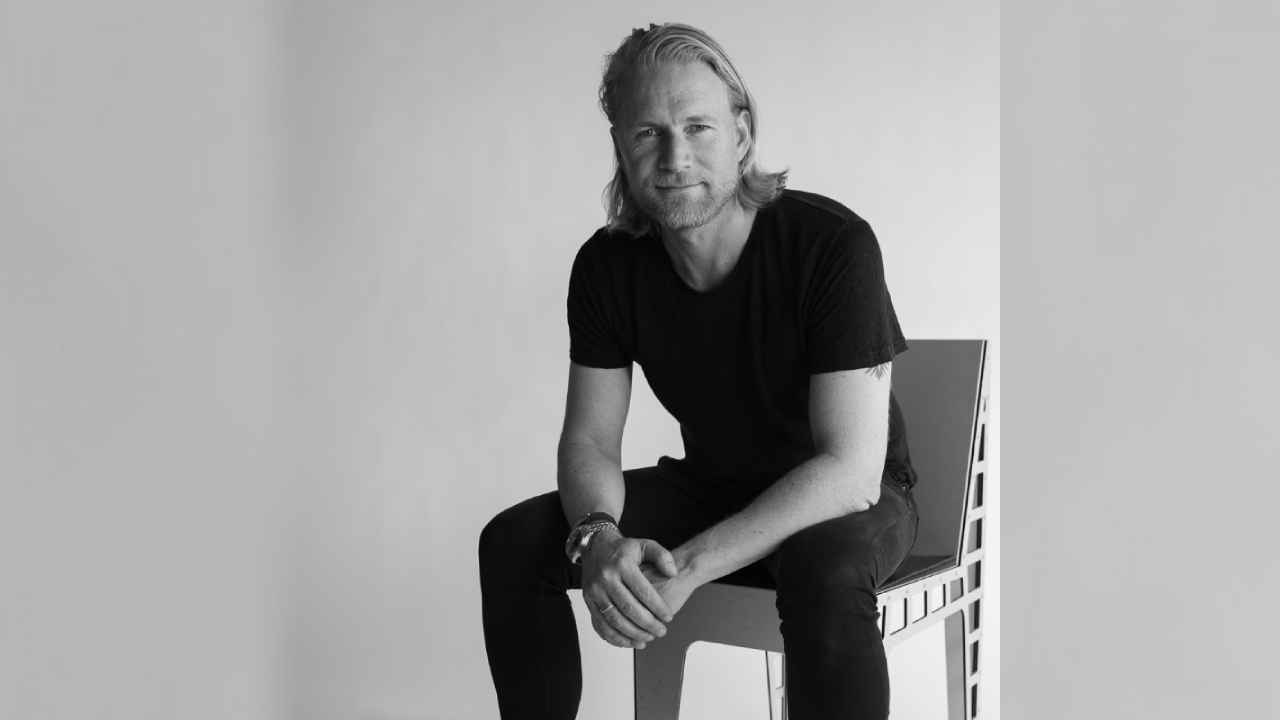

“Struggling is frustrating like beyond anything else, but it’s also exciting, living on this edge between falling or actually reinventing yourself and the business into a new successful way. That is entrepreneurship in my opinion”, Nicolas Kjaer says.
Kjaer is not letting any negative winds dismantle his energy and passion for entrepreneurship. Having three brands under his name, he is maintaining the same illusion for businesses as the first day, even though, as he explains to us, creating companies also comes with a lot of trouble. Trouble that future entrepreneurs need to be aware of not to discourage them, but to prepare them.
Born in Denmark and currently located in Amsterdam, Kjaer runs Royal RepubliQ, a clothing and accessories brand, Sel Magique, specialized in premium French herbs and spices, and gives advice to other businesspeople under the consulting holding company Trojan Treasure.
In conversation with Enterprises & More, Kjaer offers valuable insight on entrepreneurship in the current times.
Which of your companies has the most activity at the moment?
Royal RepubliQ, which is more like a brand, that’s where we have the highest activity, but in terms of work dedication, I would say Sel Magique is where we have also a lot of activity currently, because a lot of things are happening there as well. So both those two are equally in focus.
The advisory and consultancy part, that’s a bit more from time to time when that occurs. That’s where I can share my experience, my view on things and guidance to other entrepreneurs and give my opinion about what could be good things to do in a certain company.
I don’t see Trojan Treasure as a dedicated entrepreneurship. That’s more where you have consolidated your experiences. So that you are actually using your life experience to share and create a value for others.
Why did you decide to share your insights regarding Trojan Treasure instead of keeping it to yourself? And what is it that you like about helping other entrepreneurs to achieve their goals?
From a personal point of view, I started my first business when I was in my mid-20s, so it’s more than 25 years ago. And everything I have done, I’ve done it because I believed in it. It has been passion driven. And I did not have a lot of people around me, like a network of advisors who could guide me in what to do, how to get financing… I had to discover and invent myself in a lot of ways. But I really love to see ideas and projects come to life.
It gives a huge satisfaction to actually being able to see others succeed and seeing, in my situation 10 years ago, if I had someone like me to give me a few directions and be a bit critical here and there, I would probably have taken some steps faster and avoided some mistakes. And that is what drives me in that function, is really to see other entrepreneurs and businesses gain from that. So, you can say it’s nice to help, right? I was gaining a lot of satisfaction out of doing so, to see some people actually saying wow it’s amazing if I thought of that earlier.
When it comes to Royal RepubliQ and Sel Magique you are selling physical products. Is it correct that you have a physical store for Royal RepubliQ but not for Sel Magique?
We had a physical store, but we closed that in July.
So, in both cases, for Sel Magique and for Royal RepubliQ, it’s direct to consumer, e-commerce first. That’s the focus on those two. And Royal RepubliQ is a leather concept brand with focus on leather footwear for men and women, leather bags for men and women, and then belts and accessories for men and women.
We had stores for this in the past, but due to what happened, especially during COVID, we were very, very challenged. I had to close down five of the companies. We were operating in different countries and actually slim the organization down to a minimum. And that is also where we could see the only way forward for us is to have a very small organization, the very agile, very lean, low overheads in cost, and then actually seeing what actually works. And that’s what we’ve been doing the last couple of years with the with Royal RepubliQ.
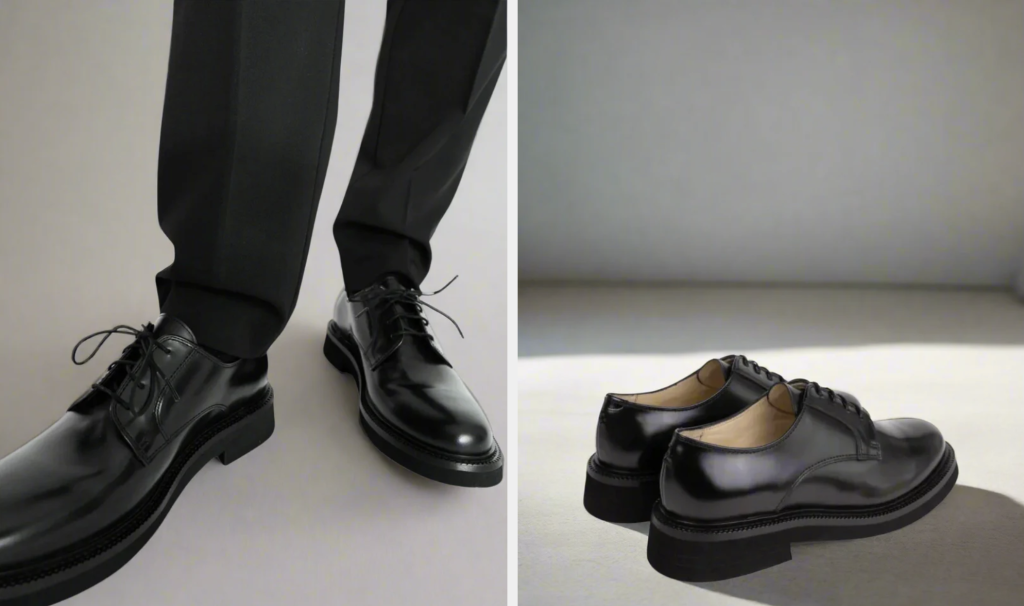
Royal RepubliQ items.
And now we are applying business to business wholesale distribution. We’re starting that up again. And we will launch in December/January. But before I did that with my own team. I built the organization for distribution, but this time I’m using a dedicated distribution partner who takes care of the entire business-to-business operation, to keep my own organization lean and agile.
In the last couple of years, the cost of having a physical place has multiplied, and at the same time, there’s a consistent boom on e-commerce. What would you say are the main advantages of focusing on e-commerce and what do you think it’s the outlook for e-commerce?
It’s a combination. To start with the stores first, if you’re not a trending brand where you are very high in the consumers’ awareness, it’s very hard to drive a physical store. So, in physical stores, there’s basically two ways, in my opinion. It is you have a niche profile. Preferably you do some multi-brands, a multi-brand store where you have different brands in, but you are trying to find a niche approach, so brands and products, which you cannot find in that many other places.
As a buyer, to create a collection for these stores, you need to work very, very hard, and have a very distinct personal profile of what kind of articles you want to present to consumers, because that will give you the attraction that people come in and say, “Wow, I don’t see this anywhere else, but I love it” and then they’ll purchase.
If you have products which is comparable with other things in the market close by, you will not have success with it. That’s one part. Or you are a strong mono-brand where you have a high awareness in people’s minds and then they can work too, but from Royal RepubliQ, we are a product driven brand, high quality, fair pricing, but we do not actually spend a lot of time and money on creating a brand awareness, marketing, etc…
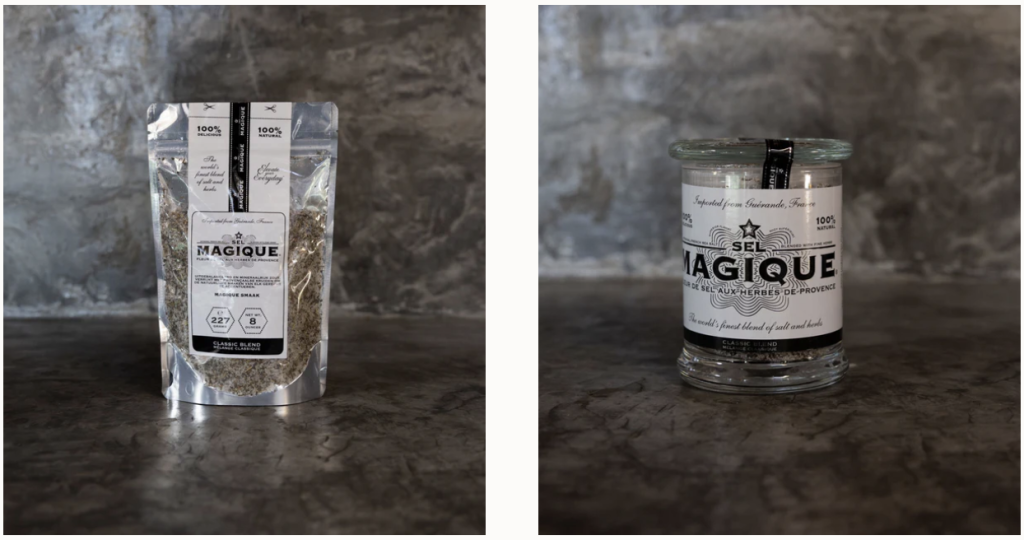
Sel Magique items.
For physical spaces you need a quite broad range of products and product categories to make it inspiring for people to come in. Because if you only have shoes, people will come in: “I need a pair of shoes. I’m lucky they found it for me”, they buy a pair of shoes and they’re happy. But if I don’t have anything else, they’re not going to come back to me before they need a new pair of shoes. So, then the returning customer rate is going down a lot.
Development cost is much smaller because you can work with a much narrower collection, and still make it interesting via content creation
So, in physical spaces you need to have a selecting of a lot of different articles So the clients will come back and say “oh, it was inspiring” and now I need clothing or I need something else I’ll come back to look at it, and then they’ll come back of course. The advantage in e-commerce is you can focus much more niche. You can say, “my collection, my articles, I can work with a quite narrow selection”. You have to go deeper so you have more stock available, but the risk is much smaller. Development cost is much smaller because you can work with a much narrower collection, and still make it interesting via content creation.
So, it’s easier to operate an e-commerce store from a product perspective versus a physical space.
Which of your companies has the best money flow?
Money wise Royal RepubliQ creates much more money, but Sel Magique is exactly what it should be, it’s a niche product.
It’s a French Fleur de Sel from the beautiful French peninsula, Guérande, at the coast of the Atlantic Ocean. It’s hand harvest. So, it’s a big story behind it, like it’s handcrafted, it’s luxury gourmet salt, which is not comparable to normal salt. This is not unhealthy. It’s healthy, natural products. And only with three flavor variants, which do not expire. We have different sizes, but we only have in bulk three flavor variants.
So that is a perfect brand to actually push on e-commerce, because you don’t need to think of seasons. You don’t need to think of expiry dates. The complexity is so small, so minimal, that you can push it on e-commerce a lot. And that is where we’ve been doing it. We are growing on e-commerce with that. And I’m learning a lot from the Sel Magique business, and I’m trying to apply it into my fashion business. To make it narrow, less complex products.
With Sel Magique we are launching with a distributor as well for the Benelux market, who will approach physical stores. But we chose a distributor who’s focusing on these physical niche speciality stores.
We focus on a distributor who will approach these so the consumer who goes to those stores, are the right consumers, who would also appreciate the brand online. So even though it’s two different, you can say branches, the consumers and the consumer behavior, we expect it to be the same. Yeah, that’s growing a lot. So, it needs a lot of attention in terms of setting things up and building a distribution and getting supply chain in place. Do we have enough products? How fast can we get materials home? How fast can we supply to big clients? All the things below the surface, which is 80% of the work to be successful, is what you don’t see.
What was the toughest moment in your entrepreneurial journey and how did you overcome it?
Yeah, that’s tough, because I am actually in the middle of my toughest period. And I have not overcome it yet.
Okay, that’s very interesting, tell me about it.
I will overcome it, and I am not in the lowest point anymore, but I’m also not out of it. It has been to close down five companies in less than two years. Seeing the fortune and capital you have saved up vanish.
So, in 2019, I had a very strong capital situation. I was self financed. I had all the money I needed, so there were no worries. And then a couple of years later, everything is gone. I’m in the middle of selling my house to pay my creditors and get free cash flow out, because I had a lot of money blocked in the house, and to actually fuel my entrepreneurship, so we can keep on growing on the path we can see it’s starting to be there.
So that’s basically the toughest point, to lose money, and have to sell your lovely house and finding a small apartment with three kids, and then have to reinvent yourself and, in principle, be willing to start from scratch without having a total breakdown.
Thank you for your honesty. People need to see that there is all this fighting for survival “behind the scenes”.
This is also entrepreneurship. If you do it all in, you can of course win a lot, but you can also lose a lot, and you can lose basically everything.
And then you can say, “Oh, I lost everything. I’m done. I’m game over”. So, “should I find a job from nine to five and get an average decent income? I can maybe get a good salary, and then I take it easy and continue my life from there”. Or do you lick your wounds and say, “Phew, that is rough. What do I do?” and reinvent yourself and listen to your intuition, and the fire you had in you, is the fire still there? It might not be a big fire, but if the flame is still there, and you dare to listen to it, and you dare to take action on it, then actually keep going.
That’s the hardest part. Most people, they break after a period of this, and then they’re out of the game in terms of entrepreneurship, which is fine, of course. But actually, being tough, being persistent, and daring to continue. That’s the hardest part, and what differentiates a real entrepreneur.
What’s your main motivation as an entrepreneur?
It is creating and building. I love to see ideas, thoughts, products come to life. I love to build a structure around it. So, an idea of creating something, there will be an amazing solution or product in the end and people will love it. And then go backwards and say, “Ah, where do we start? Oh, we start here”. And slowly building it up, create structure, get the right people involved, and then see itt come to life. That’s the biggest motivation.
The motivation is not if the “project” makes 10,000 euros or a million. The million is nicer than 10k, for sure. No, it’s actually seeing it being viable, and it gets its own life. That’s the biggest motivation. This is also what I like to do in the advisory function. I’m not an advisory for companies with 50 to 100 people. No, I have advisory function for start- and scale ups from 1-3 persons, and up to 25-30 employees. But in that phase where it’s difficult and every decision makes a difference between life and death, because you only have a certain amount of money and when you spend it, it’s gone. So, you have to spend it wisely, but you cannot be afraid.
You need to dare to take some risk, and have trust and believing to go forward. If you don’t move, you also die. That’s where I love to be a part, and seeing it come through and have the feeling that I added value, they did it, but I helped and added a bit of value to support them and shine the light for direction. So those two things, the driving force is the same in the businesses and the advisory. It is to see things succeed and come to life.
Is there any book, any mentor or experience that has shaped you as a leader, as an entrepreneur, and that you would recommend to the readers?
When I had my first child, before then, as a father, you are not carrying the baby, so you do not have the same connection as the mother has with the unborn child. You’re like, “Oh, okay, how is it going to be? Before you could go to dinner and partying three days a week until five o’clock in the morning, and now you have to prepare myself to be a professional parent. Then the questions and insecurity start to show. “What the fuck do I do, and how do I do it?”.
I got an advice from someone who said: “Everything you read and all the advice you get of how to be a parent and how to do all these things, it’s fine. The one thing you need to remember is listen to your intuition. Listen to your stomach feeling and if whatever you do feels right, just do that, keep that.” And that is not a specific book or a mentor, but to dare to feel your own stomach feeling, trust your own intuition, your own belief. If it feels right inside you, trust it, trust it. That goes for most things in life – entrepeneourship, business and private life.
Not what you read in a book of guidance. It is, “oh, that sounds super cool, super fancy. I am going to do that too”. Yeah, maybe. But try to feel if it doesn’t actually sit right in you and with your personality and your skills, not just actually apply anything because it sounds great. Does it feel right? If not, don’t do it. Do what feels really right and not be afraid of doing so.
That’s my biggest advice to people, because it sounds super easy to believe in yourself, but actually, believing so much in your inner passion and everybody around you could say “Oh no, no, don’t do it, don’t do it” but you feel it right and then you have the strength and you dare to do it. That’s the biggest power to succeeding, because everybody’s afraid and in doubt sometimes. If you are not afraid and you trust in yourself, of course with a rational mindset, you will take steps forward.
That’s one part, and then there’s another part which is the understanding of different cultures, people, backgrounds, where I think there’s the biggest effort. To actually have an open mind, not just like “I’m open-minded to everybody”. No, actually, see the world with a little bit of a child’s point of view. So if you do not understand something, that only means you actually don’t understand it – nothing more. You can keep an open mind to try to understand, and only THEN make up your own opinion.
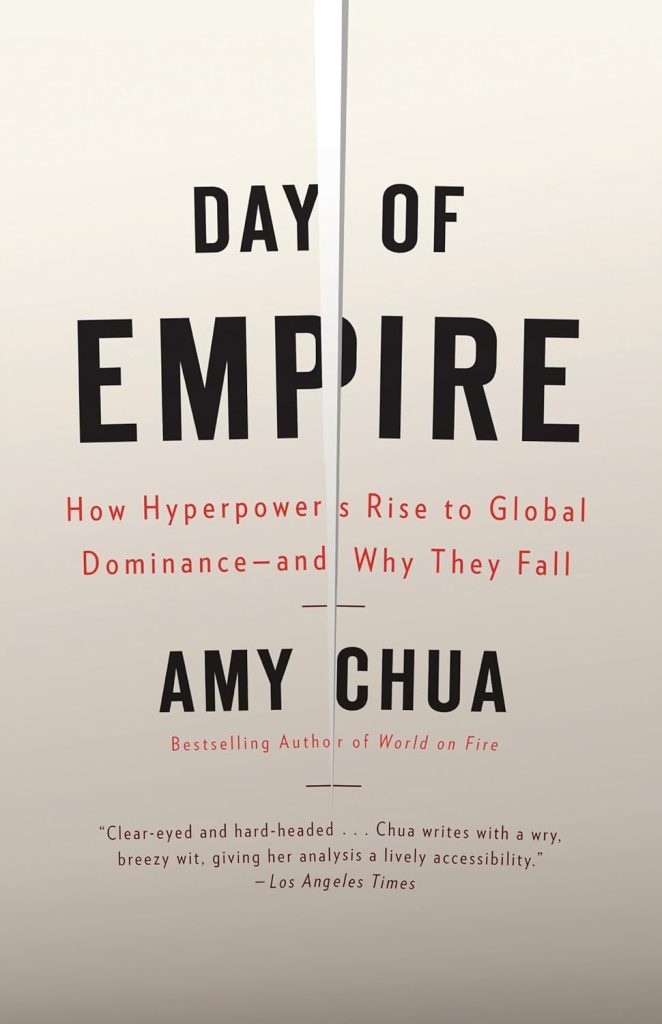
Day of Empire, book by Amy Chua.
Even if you don’t understand the culture, let’s say you are Islamic, Muslim, and you go to the mosque three times a day. Not being an Islamic, as Christians we’d be like, “that sounds super stupid. Why do they do that?” Well, I don’t know why they’re doing it so basically, I just don’t know. Maybe I should try to listen and learn and talk to people who actually do it, and try understand what drives them to do it, so this understanding of other persons drive in whatever they do, that’s the biggest driver. You have this mindset of not judging but trying to understand.
And there’s one specific book which actually is extremely well written, is an American Chinese author, her name is Amy Chua. She wrote a book called Day of Empire. It’s a description of how does the hyperpowers rise and why do they fall. So, she goes back historically and looking at why does a region become a hyperpower. Why did the Romans become a hyperpower? Why did the US become a hyperpower? And when do they start to lose their power and decrease and fall?
She’s writing it out from this point of view, but it’s applicable for us as normal people and in organizations. It’s exactly the same. It goes down to open-minded and being tolerant. Being tolerant for things you don’t understand. Embracing things, you might not like, but finding a way to embrace it so you can co-work, you can co-exist. Because then it creates peace, peace creates dynamics, and dynamics create results.

