

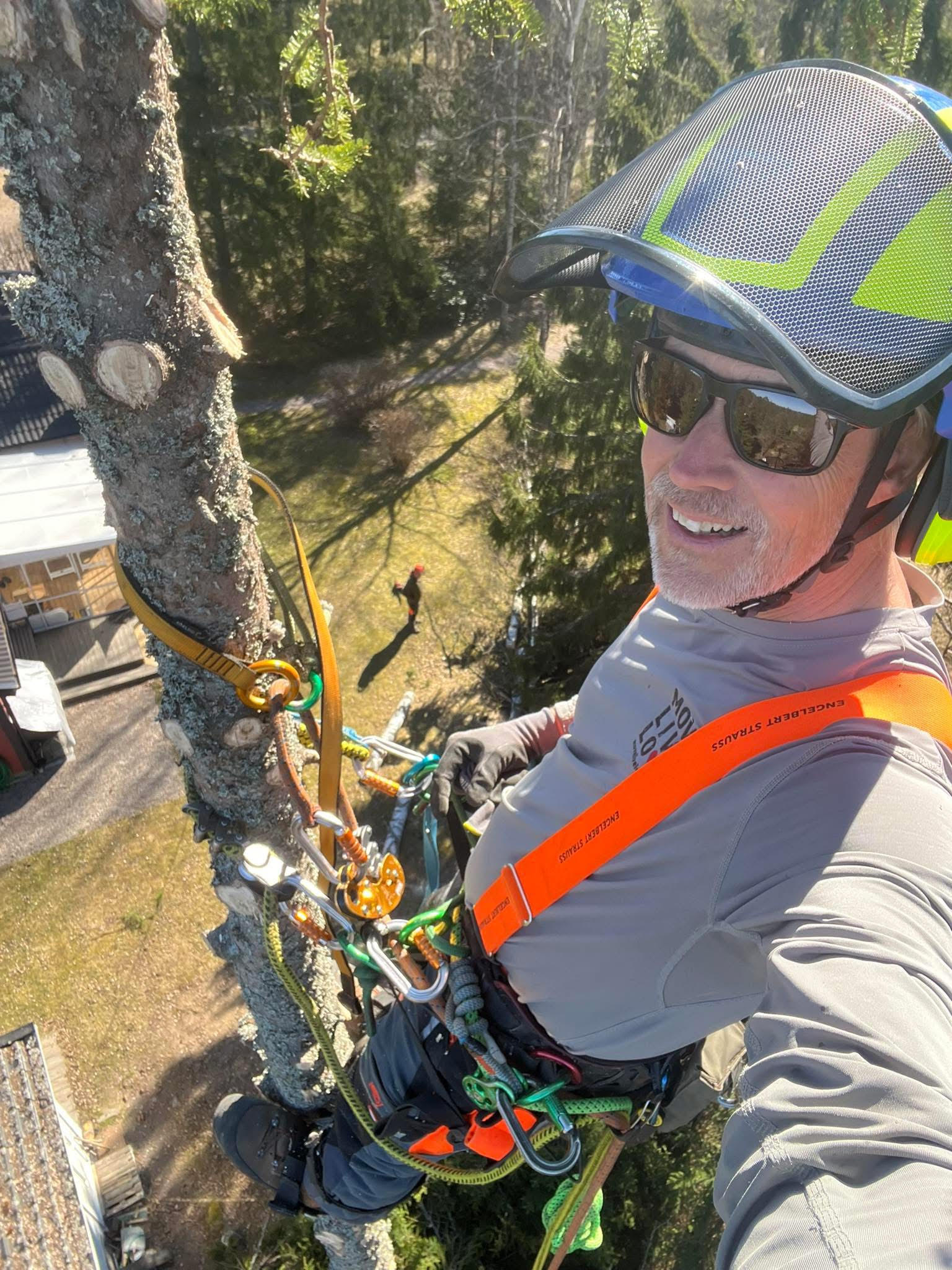

Torgny Steen: Reinventing Entrepreneurship Forestry and Resilience
Founder & Owner, Träd & Ved Entreprenörerna Sverige AB
Nationality: Swedish
Passion: A lifelong passion for sailing, boating and the archipelago — combined in recent years with professional tree climbing, tree care and forestry.
Tell us about your business and what you do?
After more than 20 years working in sales projects and business management within the media industry — followed by a decade as a speaker, trainer and coach focused on movement, brain health, learning and physical wellbeing — I decided to completely change direction during the Covid pandemic. I shifted the focus of my business toward professional tree felling, tree care and firewood sales. Today, as a professional tree feller and forestry contractor, we work with a broad customer base that includes private homeowners, construction companies, forest owners, municipalities and road associations.
What drives and motivates you?
Change is constant. Those who fail to evolve eventually become irrelevant. For me, it is all about curiosity, continuous learning and personal development. I believe you must always be prepared to adapt in order to achieve meaningful growth and long-term success.
What career highlight do you consider your greatest success?
I’ve been fortunate to work in organisations that challenged me constantly and pushed me far outside my comfort zone in order to achieve — and often exceed — ambitious goals. Yet today, at the age of 64, I genuinely feel that I have found exactly the right place professionally and personally. The past five years spent building my current company may not yet represent my greatest success, but they are certainly on the path to becoming it. I am incredibly excited to see what we can achieve over the next five years.
What characteristics define a successful entrepreneur?
There is an important difference between being a business owner and being an entrepreneur. To me, entrepreneurship means being so passionate about your idea and your company that, from the outside, it almost looks obsessive. You need creativity, curiosity, endurance and — ideally — a supportive and patient family around you. Entrepreneurship is not simply a profession. It is a lifestyle. You can clearly see this mindset in entrepreneurs such as Ingvar Kamprad, Daniel Ek, Jan Stenbeck, Mark Zuckerberg, Elon Musk, Steve Jobs and Richard Branson.
What was the original vision behind your latest venture, and how has it evolved?
Before entering forestry and tree care, I lectured extensively about movement and brain health. My vision at the time was to help children and young people better understand how movement affects learning, wellbeing and long-term health. In many ways, it became a “kamikaze project” during the early years. The Swedish school system showed limited curiosity and resistance toward implementing simple movement-based practices in classrooms, despite the potential benefits for learning and wellbeing.
As interest from parents and children grew, we expanded into weekend programmes such as CreativeChildren Camp and BiggestWinner alongside our lectures and book publishing activities. Everything changed when Covid restrictions intensified. It became clear that it was time to move in a completely new direction. During a crisis meeting with my brother in his seaside sauna, he asked me a simple question: “You haven’t thought about getting a chainsaw licence?”
That question became the starting point of what has now developed into a growing tree felling and forestry business over the past five years. Initially, the vision was simply survival during uncertain times. Today, we are a team of three working full-time year-round with the ambition of creating “a safer, more beautiful and warmer Sörmland through professional tree felling, tree care and firewood”. A major milestone came when we were named “New Entrepreneur of the Year 2024” in Trosa Municipality by Trosa Municipality and the New Entrepreneur Centre in Eastern Sörmland.
How do you balance short-term results with long-term strategy?
At my age, balancing long-term ambition with practical realities is both challenging and humbling. I feel fortunate to still be building a company and pursuing another career. At the same time, I recognise that health is my single most important asset. I do not have the luxury of waiting for opportunities to appear. Decisions need to be made quickly in order to create both short-term momentum and long-term value.
One example was our decision in autumn 2024 to invest in a Kranman Bison 6000X Plus mini forwarder. Previously, we relied on subcontractors for assignments requiring forwarders, which reduced flexibility and increased costs. By January 2026, after one full year with the machine, we could clearly see the benefits. In the short term, it improved operational flexibility and financial performance. Long term, it has strengthened our market positioning and enabled new partnerships that otherwise would not have been possible.
We made a similar strategic move when taking over a firewood business in summer 2024. In the short term, it improved revenues. In the longer term, it broadened our customer base and created opportunities to convert firewood customers into tree care and forestry clients. In many ways, entrepreneurship is about accelerating and braking at the same time.
If you had to rebuild your company from scratch today, what would you do differently?
I was fortunate to begin my journey as a subcontractor within an established tree-felling business. It allowed me to gain experience that otherwise might have taken a decade to acquire independently. That said, if I had known then what I know now about workplace safety requirements, environmental standards and operational procedures, I would have invested even more heavily in training and skills development from day one.
What principles guide your leadership style?
Leading by example. Whether I work as a subcontractor, employee or business owner, I always strive to be the hardest-working person in the room. Partly because it sets the tone internally — but also because I want customers to feel confident that we are a company they want to work with again. One of our internal mottos is “5/95”, meaning we aim to belong to the five percent who consistently go the extra mile for customers and therefore achieve results that the remaining 95 percent never do.
How do you keep your team motivated during difficult times?
Transparency and communication are essential. I believe people perform best when they understand the situation, feel involved and know they are part of the solution. Continuous skills development and personal growth are also important, especially during challenging periods. After rain comes sunshine.
What management decision have you made that went against conventional wisdom?
We are currently producing a five-year anniversary supplement for our local printed newspaper, which will be distributed throughout our target market. When I explained to our Google Ads agency that I planned to temporarily reduce our digital advertising budget in order to finance the print publication, they thought I was completely crazy. We’ll see who turns out to be right.
How do you decide which ideas are worth pursuing?
I wish I could say every major decision is based entirely on detailed analysis. But the truth is that, no matter how much research, planning and consultation you do, instinct still plays a decisive role. Very often, the final decision comes down to gut feeling.
What was the toughest moment in your entrepreneurial journey?
The most difficult period was undoubtedly the transition during Covid, when my previous business activities effectively came to a standstill. At the time, it felt uncertain and overwhelming. But looking back, it also created the opportunity to completely reinvent myself professionally and build something entirely new.
What’s a risk you took that most people thought was crazy — but paid off?
At one point, as a father soon to have four children, I left a well-paid CEO position to start a company focused on transforming the media buying process. The business itself did not evolve exactly as planned, but the experience, knowledge and relationships gained along the way ultimately shaped everything I do today.
What is the most underestimated factor in building strong teams?
I have always found management’s obsession with spreadsheets and metrics somewhat overrated when it comes to building genuinely strong teams. I believe it was Tony Robbins who said: “People don’t care until they know you care.” Caring about your people, sharing a common purpose, creating accountability with real authority and helping individuals feel that both personal and professional goals are achievable — those are the foundations of strong teams.
How do you create a culture that encourages accountability and creativity?
In our industry, safety is priority number one, two and three. Unlike my previous corporate life — where a miscalculated Excel sheet might upset management — mistakes in forestry and tree felling can lead to serious injuries or equipment damage. That reality creates a very strong culture of accountability. Through training, certifications, strict safety procedures and constant communication, we ensure that everyone participates in decision-making and that the safest and most effective methods are always chosen.
What do you wish someone had told you at the start of your career?
You overestimate what you can achieve in one year — and underestimate what you can achieve in ten.
Where do you see the biggest opportunities in your industry over the next five years?
The Swedish forestry industry is entering a period of significant transformation. Heavy logging practices over long periods risk creating timber shortages, while global requirements for carbon storage and changing international pulp production dynamics are reshaping the industry. This will likely increase interest in more sustainable and selective forestry methods using smaller-scale machinery and gentler harvesting techniques.
As a PEFC-certified forestry contractor, we see strong opportunities to support smaller forest owners with these alternatives. There is also a growing need to improve understanding among property owners and communities regarding safety standards and legal responsibilities connected to tree felling work. With our certifications, licences and position as one of the few Certified Professional Tree Climbers in our region, we believe we are well positioned for that future.
If you had unlimited resources, what problem would you solve first?
As cliché as it may sound, I would want to help end the suffering and destruction caused by the war against Ukraine. Closer to home, I would invest in building or purchasing our own facility with offices, workshops and warehouse space to support the continued growth of the company.
What legacy do you hope to leave behind?
I hope people see that something positive can emerge from crisis — if you keep moving forward and refuse to give up. I also hope to prove that even later in life, by combining accumulated business experience with personal resilience, it is possible to build a sustainable company that can continue to thrive long after you step away from it.

